
Equity by Design: Behind Tidal Equality’s Strategy Method
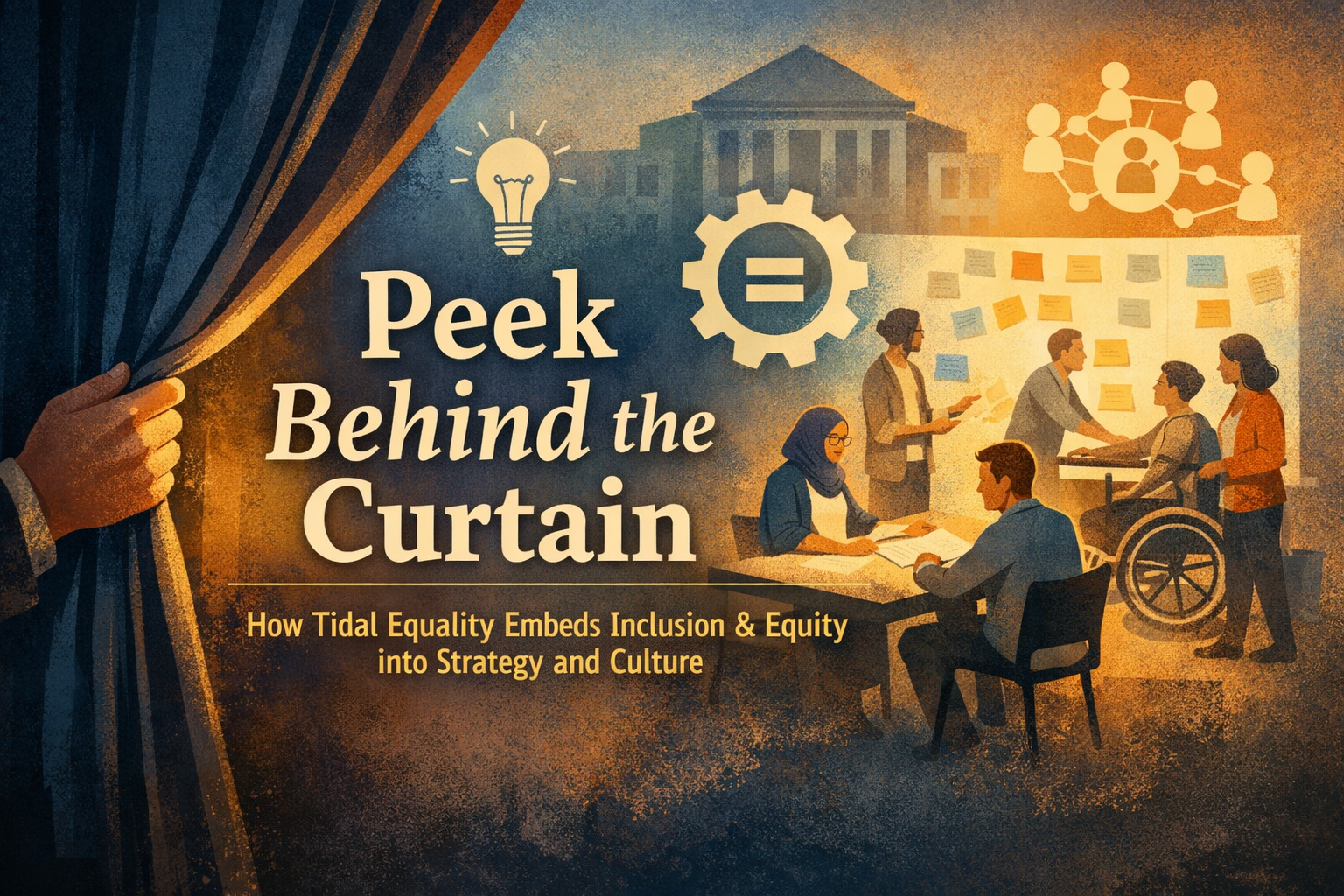
Image of word “culture” crumbling like shattered concrete. Atop the crumbling word are aimless-seeming human silhouettes.
Peek Behind the Curtain
How Tidal Equality’s strategy and culture design embed inclusion and equity into process and outcomes
Let’s be honest: most institutions say they care about equity. Many have diversity statements, values posters, and a list of DEI initiatives meant to signal commitment. But when it comes to how decisions are made—how strategies are built, how culture is shaped—equity is still treated like an accessory, not an engine.
At Tidal Equality, we do things differently. We don’t ask clients to "add equity in" after the fact. We design strategy and culture processes where equity is embedded at every level—from how priorities are set, to how teams collaborate, to how resources are distributed.
This approach embodies equitable innovation, and it’s how we help institutions move beyond rhetoric, avoid performative efforts, and design systems that can produce fairer outcomes by default.
Our core belief is that if equity isn’t built into your strategy and culture design, it won’t show up in your outcomes.
The good news? Equity doesn’t need to slow you down. In fact, it can make your institution more innovative, more resilient, and more trusted if it’s embedded into your operating system, not tacked on later.
Here’s how we do that.
9 Ways Tidal Equality Embeds Inclusion and Equity into Strategy + Culture Design
1. We treat equity as a strategy condition, not a side initiative
Most institutions treat equity like a “layer” added after strategy is built—or a set of standalone initiatives housed in a DEI office. Our approach assumes the opposite:
Equity is baked into how strategy is formed
Equity determines what counts as value
Equity shapes who has influence over priorities
Equity is reflected in capacity distribution and decision-making rules
Equitable by design = strategy that does not rely on invisible labour, unequal influence, or exclusionary assumptions to succeed.
2. We insist on co-creation as a legitimate form of governance
We don’t “consult stakeholders”—we co-create with them. Strategy and culture must be socially authored, not handed down. Co-creation is not a courtesy—it’s a governance mechanism for:
Legitimacy
Accuracy
Real buy-in (not checkbox participation)
Distributed agency
Surfacing missing perspectives before harm happens
This is inclusive by design—because those who live the strategy help shape it. And equitable by design—because it redistributes power.
3. We elevate lived experience to the level of strategic intelligence
In most institutions, expertise = rank or credentials. We challenge that.
Lived experience is also evidence. Without it, strategy fails to account for real-world conditions—and creates friction, backlash, and harm. When lived experience becomes a formal input, your strategy becomes:
More accurate
Less extractive
More resilient under pressure
Less biased
More human
4. We view culture as an outcome of conditions—not a moral failure
Culture challenges are often misdiagnosed as people problems. We see them as system problems:
Unclear expectations
Inequitable workloads
Opaque decisions
Unrealistic assumptions about capacity
We reject scapegoating and blame, and instead focus on changing the strategic and structural conditions that shape behavior.
5. We build strategies that protect capacity and reduce inequitable strain
When strategy ignores capacity, implementation depends on:
Heroic labour
Unpaid emotional work
Burnout (especially of equity-deserving team members)
We help leaders design strategies that match real capacity and distribute workload fairly—so progress doesn’t come at the expense of people.
6. We treat values as operational—not decorative
Too often, “values work” lives in a mission statement and nowhere else. We embed values into decision frameworks, tradeoffs, priorities, and accountability systems. That means leaders have to ask:
“Is this decision aligned with what we say we value—and for whom?”
Operationalizing values is how we make fairness actionable—not just aspirational.
7. We translate values into behaviours—which makes inclusion measurable and livable
Our Culture Charter or Community Blueprint models create clear behavioural expectations across your institution. This reduces:
Ambiguity (which enables bias)
Culture drift (which privileges dominant norms)
Uneven enforcement (which harms marginalized groups)
When behaviours are shared and explicit, inclusion becomes a practice—not a vibe.
8. We design for distributed decision-making and shared power
We believe that strategy should be legible and actionable across all levels of the institution. That means:
Teams can prioritize without permission-seeking
Decisions don’t depend on proximity to positional power
Change doesn’t get bottlenecked at the top
This approach directly counters centralization and elitism—two major sources of institutional inequity.
9. We don’t separate strategy and culture—we align them as one system
Most organizations treat strategy as “hard” and culture as “soft.” We integrate them:
Strategy creates conditions
Values shape choices
Behaviours reinforce norms
Culture becomes the lived experience of the strategy
When strategy and culture are aligned, equity and inclusion become inevitable—not optional.
What This Means for You
If you’ve ever wondered how Tidal Equality’s work looks and feels different, this is it.
We don’t build abstract strategies or one-off culture interventions. We redesign systems—with you and your people—to make fairness a feature of how your institution operates.
Our methods are intentionally designed to be:
Inclusive by process
Equitable by structure
Grounded in lived realities
Measurable and actionable
Scalable across teams and departments
Whether we’re facilitating a Culture Charter, co-creating a strategic plan, or training your internal changemakers in the Equity Sequence®, our goal is the same:
To help you build an institution where strategy and culture are coherent, inclusive, and built to last.