
Lessons from the Community: If the Nervous System Isn’t Settled, Change Isn’t Possible
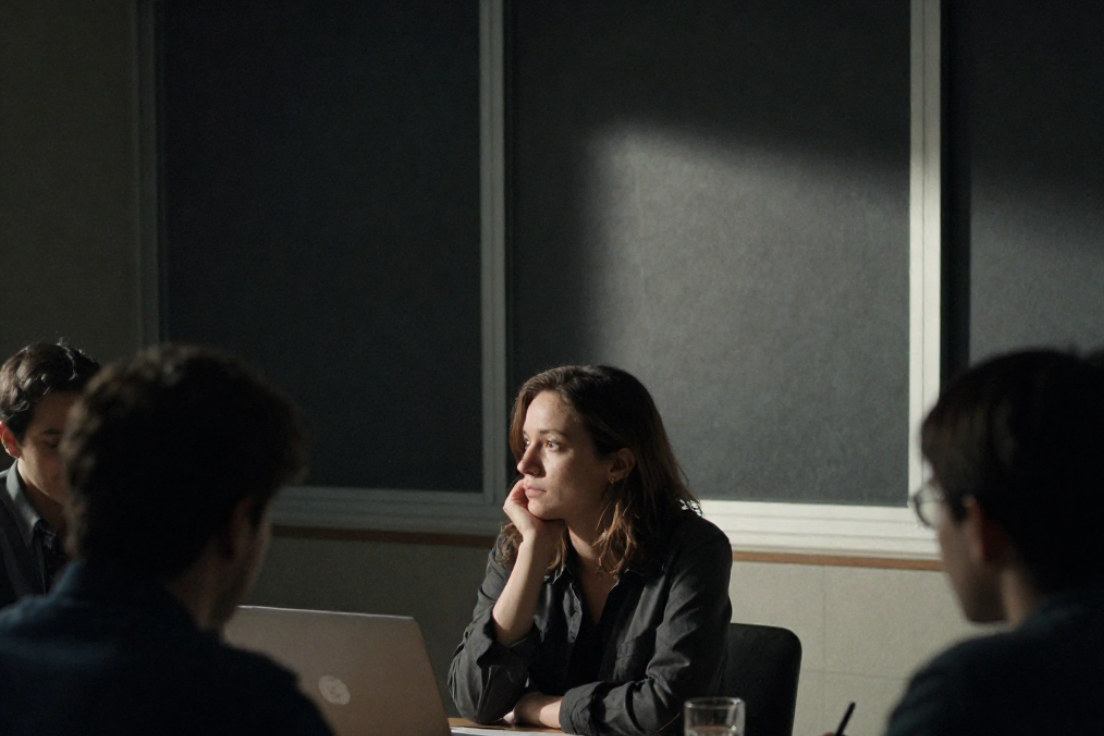
A woman sits at a table in a meeting room, resting her chin on her hand and looking thoughtfully to the side. She appears pensive or disengaged, while others around the table—slightly out of focus—look down at laptops or notes. Natural light from a window highlights her face, creating a quiet, reflective mood.
Lessons from the Community: If the Nervous System Isn’t Settled, Change Isn’t Possible
A Shift in What People Are Bringing Into the Room
I hosted a reunion last week with alumni from the first and second Certified Equity Sequence® Trainer cohorts. The group spanned sectors, geographies, and roles, but the conversation quickly converged on a shared reality: Across their work and lives, people are operating under sustained pressure—organizational change, political uncertainty, economic strain, and personal transitions. This context is shaping not only what people bring into conversations, but what they are able to contribute once they arrive.
Lanie Lockwood (Assistant Dean for Student Affairs, San Diego State University), spoke candidly about this in her own context, describing how the pace and intensity of change in her environment have created a sense of constant strain. There is little room to process, and even less certainty about what comes next.
That kind of sustained pressure does not stay outside the room. It travels with people into meetings, into conversations, into decisions. It shapes what feels possible.
I opened the session by sharing a recent insight from our work at Tidal Equality: Increasingly, I am seeing that when people are in a heightened state – whether anxious, overwhelmed, or defensive – they are not able to engage meaningfully in conversations about change.
Marc Iturriaga (Executive Director, Mohawk Students’ Association) captured this dynamic clearly when he reflected that people are often arriving with years of experience that it is not safe to speak candidly, and that history does not simply reset because a new conversation begins. Even well-designed processes and thoughtful questions fall flat when the conditions are not right.
Recalibrating How We Show Up
Several participants described a shift in how their usual ways of engaging are landing. Sula Levesque (University of P.E.I.) shared something that those of us who are conveners and facilitators have likely felt but perhaps not yet named: “I’ve always valued my high energy… previously it has been perceived as engaging and inspiring. But now, people just feel too overwhelmed for that energy.” That realization prompted a change in how she approaches her work, placing more emphasis on creating calm and stability at the outset of interactions.
Sula went on to describe what that looks like in practice: “The way in… is to create a sense of calmness… a space where people feel held and supported.” This is less about personality and more about responsiveness. In a different moment, energy might have been the way into a room. Right now, a steady presence is often what allows people to stay.
She added something poignant: “The shifts required, in tone or in style - may not always come ‘naturally’ or easily and that leaders and facilitators need to be supported in this work, especially since we, too, are navigating the same global, institutional and personal pressures.”
Finding Entry Points That Feel Human
Others described small but effective ways of helping people ease into conversations. Jeff Joines (Associate Dean, NC State University) shared that he often begins meetings with something intentionally low-stakes: “We start with a fun question… something with no stakes.” A favorite movie, a light prompt—something that allows people to arrive as people before being asked to engage as professionals.
Elaine Heier-Watt (EDI specialist) offered another approach that initially seems unexpected, but is deeply intuitive once you hear it: “People love a good coloring sheet… or making something with their hands.” In sessions where the content can be heavy or complex, this creates a different point of entry. People settle. They soften. They begin to talk more freely.
Recognizing the Weight People Are Carrying
There was also a recognition that people are bringing more of the external world into their work than ever before. Ben Bradshaw (Counsellor), drawing on his experience in therapeutic practice, spoke to this directly: “What you’re feeling is a normal response to the chaotic world we live in… your body is doing what it’s supposed to do.”
That framing matters. When people believe they are overreacting or failing to cope, they often withdraw. When they understand their response as human and appropriate, they are more able to stay present and engage.
Lanie’s earlier reflection sits alongside this. The conditions she described are not unusual. They are increasingly common. And they help explain why so many people are arriving to conversations already at capacity.
The Role of the Container
A number of insights focused on the structure of interactions themselves. I reflected on a familiar scenario: a senior leader speaks at length, then poses a significant question with only a few minutes remaining for discussion. The silence that follows is often interpreted as disengagement, but it’s more simple, and perhaps more disappointing, than that: that’s not engagement, it’s a missed opportunity.
The issue in these moments is not a lack of insight or willingness. It is the container. Time, power dynamics, and psychological safety all shape what is possible in a given interaction.
Making Space for Thoughtful Engagement
Several participants are experimenting with ways to expand that container. Helen McLean (EDI Partner, University of Hull) described a simple shift that has had a noticeable impact in her work: “Please feel free to share any reflections or ideas that come to mind after the meeting, as these help inform our approach and next steps.” By removing the expectation of immediate response, she has seen people engage more thoughtfully and follow up with more considered input.
Others spoke about addressing power dynamics more directly. These adjustments are not always easy to implement, but they are often necessary to create the conditions for meaningful participation.
The Ongoing Challenge of Trust
Trust remains one of the most complex and persistent challenges. Marc spoke to the difficulty of building trust in environments where people have experienced the opposite: “They still have years of experience… that it’s not safe to speak.” Even when leaders are sincere in their desire for input, that history shapes how people respond.
In many settings, there is limited time to rebuild that trust. Under these conditions, trust must be demonstrated consistently, often in small ways, over time.
Not Doing This Work Alone
One of the more subtle but important insights came from Jamie Kim (Chief DEI Officer, City of LA), who reflected on the value of not holding this work alone. In environments that are complex or resistant, there is a tendency to internalize responsibility—to feel that it is up to one person to carry the conversation, to create change, to manage the dynamics in the room.
What Jamie described instead was the relief and effectiveness of having a partner in that work (shout out to Jessica Kohring). Someone to think with, to navigate difficult moments alongside, and to share the weight of what can often feel like high-stakes interactions. This does not remove the challenges, but it changes how they are experienced. It creates space for more thoughtful engagement and reduces the sense of isolation that many practitioners carry.
Modeling a Different Way Forward
One of the more practical approaches to building trust that emerged in the conversation was the role of modeling. Ian Case (theatre creator, arts advocate, administrator and consultant) shared that in his work, he has found value in being visibly imperfect: “Make lots of mistakes… and own them… that gives others space.” This creates an environment where others feel less pressure to perform and more freedom to participate.
He added that sometimes this means being willing to go first: “Be the ‘idiot’ first.” The intent is not self-deprecation, but leadership. Someone has to create the conditions for others to step in.
Reframing the Work
Taken together, these reflections point to a shift in what effective leadership and facilitation require in this moment. Technical expertise and well-designed processes remain important, but they are not sufficient on their own. Greater attention must be paid to the emotional and psychological conditions in which people are operating.
The central insight from this conversation is straightforward but consequential. If people are not in a state where they can engage, no amount of content or structure will compensate for that. If the nervous system is not settled, people are not available for change.
Creating the conditions for engagement is not a preliminary step. It is the work itself.
What stayed with me after the session was not a new technique or framework, but a recalibration of responsibility. The work is not only to guide people through better decisions, but to create the conditions where those decisions are even possible. That requires a different kind of attention—one that is slower, more relational, and more attuned to what people are carrying. It also reinforces the importance of not doing this work in isolation. The insights shared in this conversation were not developed alone; they were shaped through practice, reflection, and exchange with others doing similar work. That collective, collaborative dimension may be one of the most important resources we have right now.
I’m grateful for our growing community of Certified Equity Sequence® Trainers and look forward to meeting the next cohort, as it comes together.
Learn more about the Certified Equity Sequence® Training Program here.