
Stop Trying to Drive Change. Start Growing It.
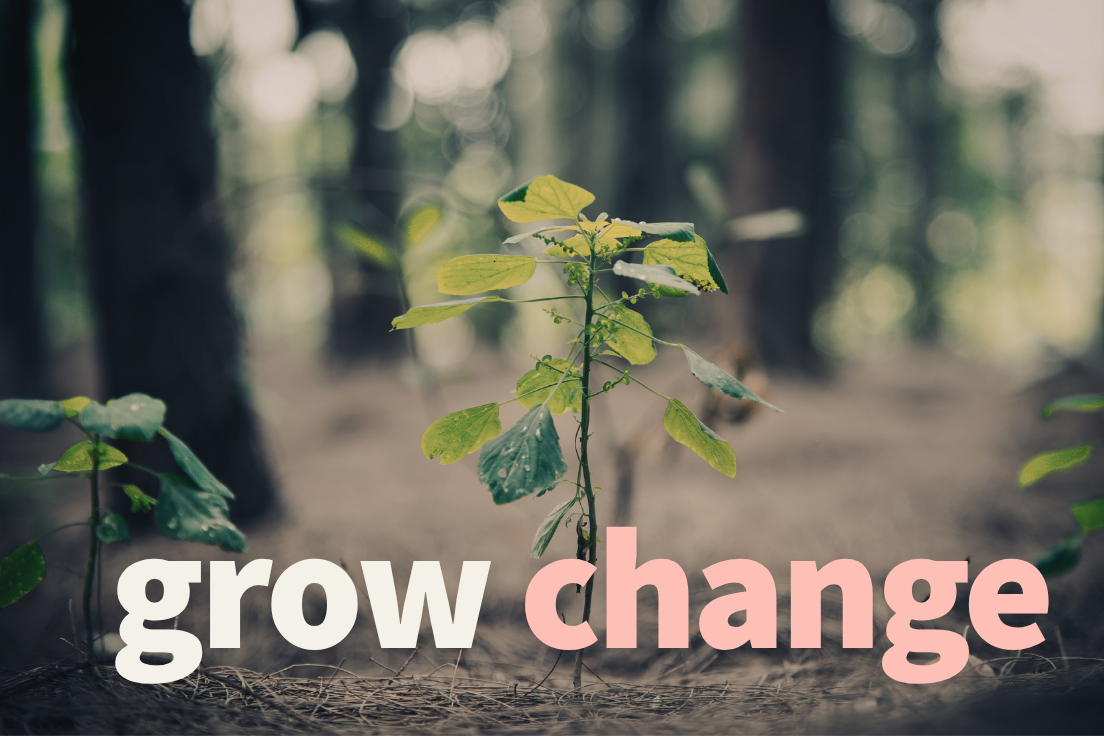
A small green sapling growing in a forest with soft sunlight in the background, overlaid with the words “grow change” in bold lettering.
There are people you don’t see often, but when you do, the conversation resumes as if no time has passed. Jess is like that for me. We’ve only shared physical space once, having met first virtually during the pandemic, and yet when we talk, something settles quickly – like stepping into a current that was already moving before you arrived. Jess has a way of being that makes it difficult to keep things confined to “work.” Not because she resists structure, but because she doesn’t split herself in the way many of us have been trained to. The person doing the work vs. the person living a life are the same person when it comes to Jess. She notices things – people, tone, shifts in energy – and she responds to them without much delay or performance. It’s attentive, it’s caring, and it’s something I love about her.
We had an hour together the other day, loosely intended as an interview, though neither of us was particularly good at staying inside those containers. We started, as you do, with how she was doing. Her family had just come back together after some time apart, and there was something visibly lighter in her. I could see it before she said it. That small detail – how quickly she located herself in relation to the people she loves – felt, in retrospect, like an entry point into everything else we talked about, though I didn’t recognize it at the time.
When Things Didn’t Go As Planned
The conversation drifted, as it tends to, toward work. She had recently facilitated a training that hadn’t gone as hoped. Not a failure in any dramatic sense, but one of those experiences that leaves a residue. A room that never quite opens. Moments of resistance that aren’t surprising, but still have an effect.
I hadn’t been there, but I know those rooms well enough to imagine them. My instinct was to analyze… to look for the point at which things went sideways… to consider what might have been done differently. But Jess didn’t approach it that way. She didn’t linger on what had been said or how people had behaved. Instead, she described the conditions those people were working inside. “They’re beyond capacity,” she said. What she described is how her participants were not just busy, not just stretched, but facing something more systemic than that. People are carrying not only their responsibilities, but a constant background hum of uncertainty and pressure. “And in that context,” she said, “people don’t have the capacity to take on anything new.”
Some People Are Carrying Too Much Already
Jess didn’t frame that as a complaint, or even as a barrier. It was an observation, offered without judgment. And it stayed with me, because it articulated something I recognize and often work around, but don’t always fully account for. It’s the assumption that so many of us make: that if something is important enough, people will find a way to engage with it. That assumption is built into so many of the structures we design: trainings, frameworks, initiatives. We act as though the primary challenge is clarity or persuasion, when in fact it may be something more basic. Whether there is space – cognitive, emotional, relational – for something new to take root at all.
When I asked her what she would have done differently in that room, she didn’t talk about changing the content or refining the message. She said she would have asked people to bring something they were already working on. A real decision, a real process, something that had to get done regardless of the training. And then she would have worked through it with them and with the Equity Sequence®. Less explanation, more application. Yes, she described this as a tactic, but also as a way of respecting the reality people are in. The wisdom she’s arrived at: You don’t ask someone at capacity to carry something additional. You enter the work they’re already carrying and try to make it better.
Finding Ways to Help, Not Add Burden
She described a small shift in design, but it reveals something I think we can all learn from right now as teams are in fight or flight because our collective and individual nervous systems are unsettled, and when that shows up as resistance, mistrust, and lack of collaboration – when what we need is care and connection. The order we tend to follow (number one: understanding, number two: application) assumes a kind of discretionary effort that may not exist. What Jess was describing reverses that. Start with the work. Let usefulness establish its own form of credibility. If something proves itself in practice, people don’t need to be convinced in the same way. They’ve already experienced it.
From there, my conversation with Jess moved into a broader question about influence. Not in the abstract, but in the way it operates in her day-to-day life.
Sphere of Concern vs. Sphere of Influence
Jess works at the L.A. Zoo, across a system she doesn’t control, moving between departments with different cultures, different levels of openness, different histories. I asked her how she thinks about expanding her influence in that environment. I share a phrase I first heard from another leader stewarding a difficult system, who advised one to learn the difference between our sphere of concern and our sphere of influence. I expected Jess to say something about strategy or positioning or finding a path of least resistance. What she said instead was that you need to build relationships. You “water” people.
She elaborated in a way that made it clear she wasn’t reaching for a metaphor, it was one she had on hand.
Watering… You check in. You listen. You help where you can. You become someone people trust to think with. Not as a means to an end, but because that is how you move through the world. And over time, that changes how people relate to you. They bring you into conversations earlier. They ask for your perspective. They begin to rely on you in ways that extend beyond your formal role. Influence, in that sense, isn’t something you assert. It’s something that accumulates through relationship.
Tending To Relationships To Create a Resilient Ecosystem
It was only after she said all of that that she reached for the image of redwood trees, how they share water through their root systems, how their strength is collective rather than individual. She wasn’t trying to make a point more elegant, she was trying to make it more accurate (and she was drawing on a fundamental part of herself, the part that cares deeply about wellbeing – not only the wellbeing of the people around her, but all living things). The system she’s describing doesn’t respond to force in any straightforward way. It responds to connection… to repeated, reliable exchanges that build a distributed and resilient strength.
A Different Way to Think About Change
I found myself thinking about how different that is from the language we typically use to talk about change. We talk about driving it, scaling it, accelerating it, as though it behaves like something mechanical. Something that can be moved through a system with enough pressure in the right places. But the systems we’re working in aren’t mechanical. They’re human and they’re relational. They’re shaped as much by trust and history and informal networks as they are by formal structures. And in those kinds of systems, change doesn’t move in straight lines.
Tending To Relationships To Grow Change
At some point, I started talking about relationships as something you can map like a garden, which is not language I tend to use lightly, because there’s a risk of sentimentality in it. But in this case, and in a few other cases recently, it felt grounded. Looking at the ecosystem you’re in and asking what needs tending, what’s been neglected, what’s competing for the same resources, what might grow differently if the conditions shifted slightly. Jess picked that up and connected it to something she had studied years ago,... the idea of an “integrating context.” In other words, the underlying thing that connects a group even when everything else feels (or is) fragmented. Not a set of stated values, but something more immediate. What is the thing this group actually cares about, in their work, right now? And how do you enter there, rather than asking them to come to you?
We didn’t arrive at a conclusion. That’s not really the point of conversations like this one. But I left with a clearer sense of something I’ve been circling for a while, which is that many of the ways we approach change assume conditions that aren’t present. They assume capacity where there is depletion, openness where there is skepticism, alignment where there is fragmentation. And when those assumptions don’t hold, we tend to push harder, refine the message, or try to increase buy-in.
What Jess offered, without framing it as such, was a different orientation. One that begins not with the change you want to see, but with the system as it is. The people in it, the pressures they’re under, the relationships that already exist. You work inside that. You make things better where you can. You build trust in ways that are not immediately instrumental. And you allow influence to grow from that, rather than trying to apply it from the outside.
It may be slower and less visible. It doesn’t lend itself to clean narratives about transformation. But it aligns more closely with what actually happens in the places where things do begin to shift. Not because someone drove change into the system, but because someone paid attention long enough, and carefully enough, to help something else grow.